Thermal Diagnostics & Pan Metallurgy
Get to Know Your Oven
Two bakers on opposite sides of town can weigh the exact same flour, sugar, and buttermilk down to the gram, mix for the exact same 14 strokes, and set their dials to 375°F (190°C)—yet pull out completely different muffins. One tray has tall, golden crowns; the other has burnt bottoms and raw centers. The missing variable is almost never in the mixing bowl. It is the thermal story inside your oven cavity and the reflectivity of your muffin tin.
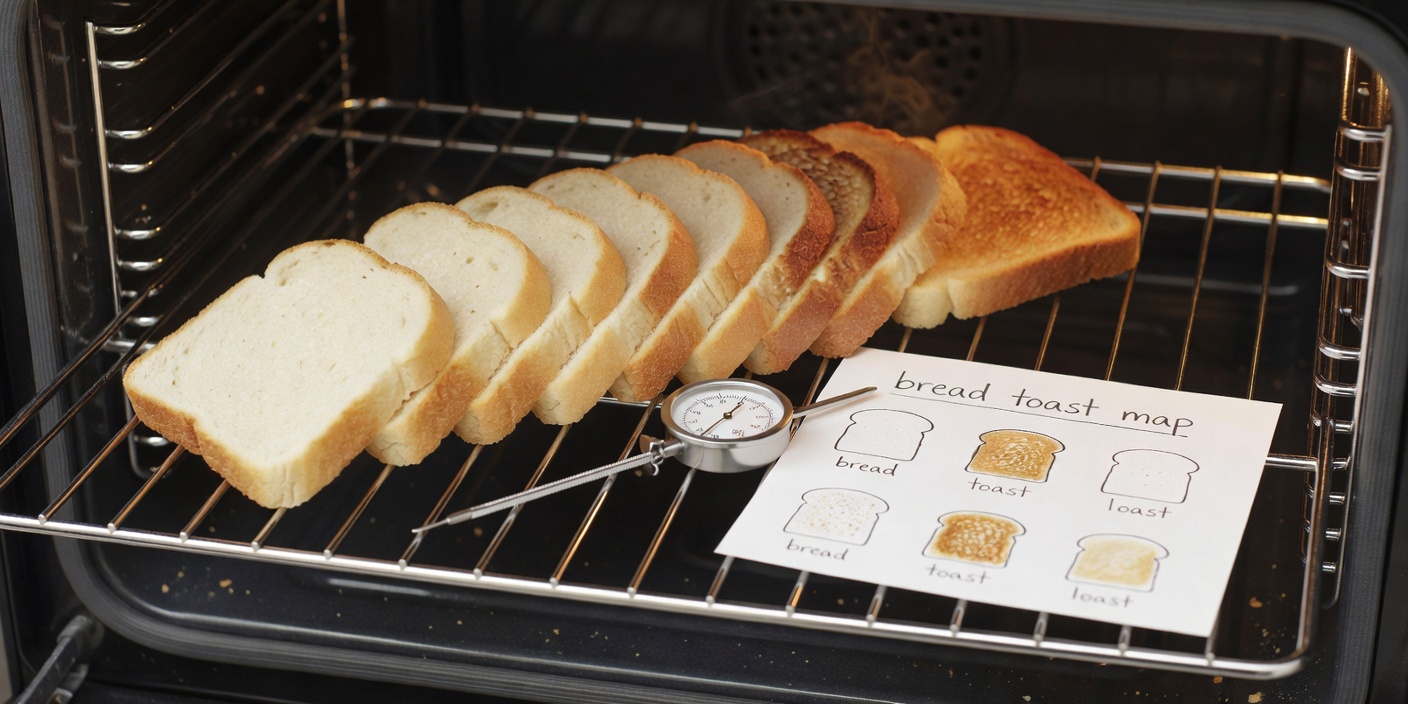
1. Why the Preheat Beep Lies (And How Thermostats Cycle)
When a modern gas or electric oven chimes to announce it has reached 375°F, it is reporting the air temperature around a single thermistor probe typically mounted near the upper back corner of the box. Air heats rapidly, but air has terrible heat capacity. The steel walls, heavy glass door, and wire racks are still 60°F to 90°F cooler. The moment you open the door to slide your muffin pan inside, that pocket of hot air rushes out into your kitchen, and the oven struggles for the next seven minutes to recover—right when your muffins desperately need maximum heat for oven spring.
"Give your oven 15 full minutes past the preheat chime—and if you keep a baking stone or steel on the bottom rack, give it 30. Thermal mass is what recovers heat when the door opens."
The 3-Reading Average Calibration Check
Residential ovens do not hold a flat line; they cycle on and off in a sine wave. To find your oven's true average temperature without buying expensive lab gear:
- Clip an inexpensive bimetal dial thermometer (or high-heat digital probe) to the exact center of the middle rack.
- Set the oven to 350°F (177°C) and let it preheat for a full 25 minutes.
- Without opening the door, read the thermometer through the window when the heating element clicks off (Peak 1), then when it clicks back on (Trough 1), and again when it clicks off (Peak 2).
- Average the peak and trough numbers. If your 350°F setting cycles between 315°F and 345°F, your true average is 330°F—meaning you need to set your dial 20°F higher or calibrate the knob offset in your oven's user settings.
2. Pan Metallurgy: Light Aluminum vs. Dark Nonstick vs. Silicone
Heat travels into muffin batter via three pathways: convection from moving air, radiation from the hot oven walls, and conduction through the pan walls. The color and conductivity of your pan change the balance dramatically.
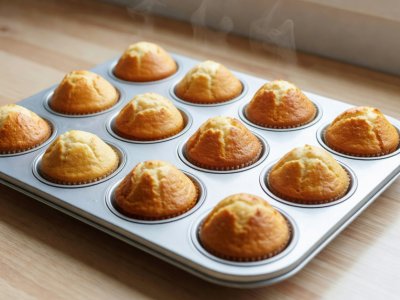
Even Conduction Without Edge Scorching
Unquoted aluminum or light aluminized steel (such as USA Pan or Nordic Ware Naturals) conducts heat rapidly across the cups while reflecting harsh infrared radiation. The center finishes baking at the same moment the rim turns golden.
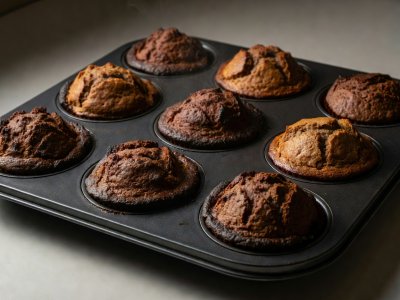
Absorbs Radiant Heat Fast
Dark gray or black fluoropolymer coatings absorb infrared radiation like black asphalt in July. Side and bottom crusts set and darken 20% faster, often leaving a thick, dry rind before the dome finishes rising. Reduce oven temp by 25°F when using dark tins.
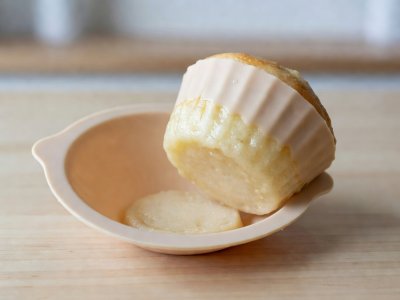
Poor Thermal Conductivity
Food-grade silicone is a thermal insulator, not a conductor. While muffins pop out easily, the sides and base never reach the 310°F+ required for Maillard browning, resulting in pale, spongy sides and a lower dome.
3. Convection Fans, Rack Height, and the High-Low Bakery Trick
Many modern home ovens include a "Convection Bake" fan. While convection is wonderful for roasting vegetables or baking multi-rack shortbread cookies, high-velocity air can sabotage delicate muffins. If the fan blows across the top of a muffin pan during the first 6 minutes, it dries and sets the top skin prematurely—creating either a lopsided, wind-swept lean (pointing away from the fan blade) or a volcano crack when the wet interior bursts through the dry crust.
| Oven Variable | Effect on Muffin / Quick Bread | Recommended Kitchen Protocol |
|---|---|---|
| Convection Fan On | Accelerates surface evaporation; causes leaning domes and cracked crusts. | Use conventional (still) thermal bake for muffins and quick breads. If convection cannot be disabled, reduce temperature by 25°F and shield from direct fan draft. |
| Upper Third Rack Position | Increases top radiant browning from ceiling reflection; spares bottom crust from bottom element scorch. | Ideal for dark pans or high-sugar streusel toppings that need crisp browning without burning the base. |
| The 425°F → 350°F Bakery Spring | Bursts steam and double-acting baking powder in the first 5 minutes, setting tall vertical walls before the batter can spread over the tin deck. | Preheat to 425°F (218°C). Load pan, bake 5 minutes with door closed, then turn dial down to 350°F (177°C) for the remaining 13–15 minutes. |
Ready to put your calibrated oven to work on a deliberate test? Head over to our single-variable kitchen experiments to see how resting time, sugar particle size, and alternate cup spacing transform your next batch.